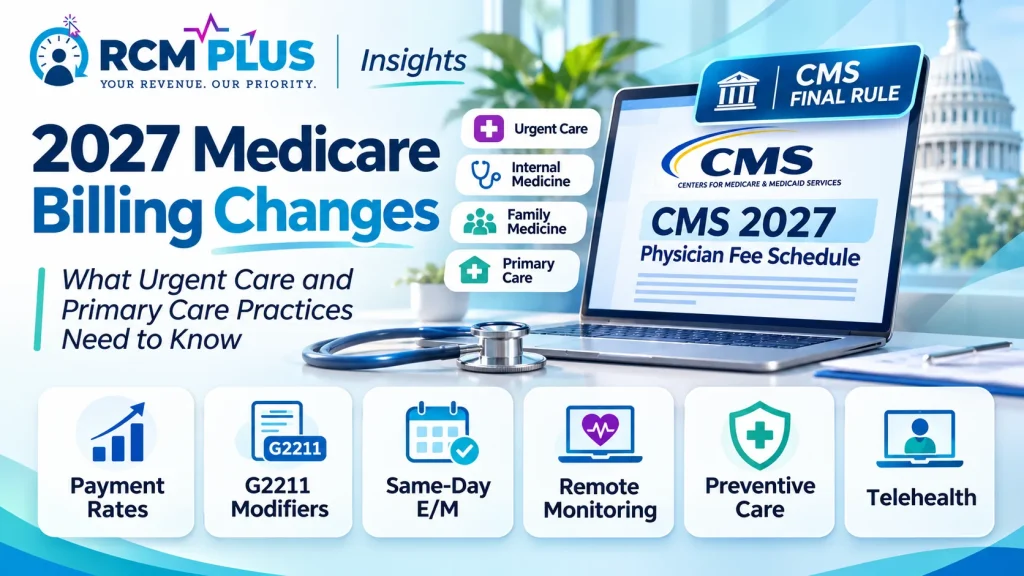
A practical guide to the finalized 2027 Medicare Physician Fee Schedule, including reimbursement changes, updated billing requirements, and steps practices should take before January 1, 2027.
The 2027 Medicare Billing Changes introduce important updates for urgent care centers, internal medicine practices, primary care physicians, and family medicine providers. From physician payment rates and evaluation and management (E/M) services to remote patient monitoring and chronic care services, several provisions could affect how practices prepare, submit, and reconcile Medicare claims.
On November 4, 2026, the Centers for Medicare & Medicaid Services (CMS) released the Calendar Year 2027 Medicare Physician Fee Schedule Final Rule (CMS-1848-F). Most of its payment-policy changes take effect January 1, 2027.
For healthcare practices, understanding these changes before implementation is important. Even small differences in modifier reporting, claim processing, or reimbursement calculations can create avoidable billing problems.
At RCM Plus LLC, we believe that staying informed about regulatory changes is part of maintaining accurate, accountable revenue cycle operations.
Here is what medical practices should know and how they can begin preparing.
In This Article
2026 vs. 2027 Medicare Billing: Quick Comparison
Before reviewing the individual policies, the following comparison highlights some of the most relevant changes affecting Medicare physician billing.
| Billing Area | 2026 Rules | 2027 Rules |
|---|---|---|
| Physician Payment Conversion Factor | $33.40 for non-QPs; $33.57 for qualifying APM participants | $32.63 for non-QPs; $32.95 for qualifying APM participants |
| G2211 Complexity Add-On | Separate add-on code for qualifying E/M services | Transitions to modifier B1 with a 16% payment adjustment |
| ACO Longitudinal Care | No equivalent B2 modifier | Modifier B2 provides a 32% adjustment for qualifying practitioners and services |
| Same-Day E/M and Procedures | Separate payment follows applicable E/M and procedure billing rules | New adjustment: 100% for highest-valued eligible service and 80% for other eligible services when separately identifiable E/M and zero-day global procedures occur together |
| Remote Monitoring | Existing RPM and RTM billing requirements apply | New initiating-visit requirement and RTM established-patient restriction; valuation updates |
| Advance Care Planning | Existing ACP codes, including 99497 and 99498 | New G0572 and G0573 distinguish qualifying clinical staff services from practitioner-performed time |
| Medicare Telehealth | Extended statutory flexibilities already available | Applicable flexibilities continue through December 31, 2027 |
These changes do not apply identically to every medical practice. The impact depends on specialty, place of service, Medicare participation, the services furnished, and the associated billing requirements.
1. Medicare Physician Payment Rates Are Changing
CMS finalized two Medicare Physician Fee Schedule conversion factors for calendar year 2027.
| Payment Category | 2026 | 2027 | Change |
|---|---|---|---|
| Qualifying Advanced APM Participants | $33.57 | $32.95 | -1.83% |
| Other Practitioners | $33.40 | $32.63 | -2.31% |
These conversion factors are components of Medicare’s payment calculation, not the reimbursement amounts assigned to individual office visits.
The decreases reflect several statutory and payment-policy factors, including the expiration of a temporary 2.5% conversion factor increase that applied during 2026.
Actual payment for a service also depends on its relative value units (RVUs), geographic adjustments, practice setting, and applicable payment policies.
What Should Practices Review?
Urgent care and primary care practices should compare their most frequently billed CPT and HCPCS codes against the finalized 2027 Medicare fee schedule.
For internal medicine and family medicine, this may include office visits, chronic disease management, and preventive services. Urgent care practices should also review commonly performed minor procedures and separately payable services.
Applying a single percentage reduction to every claim would not provide an accurate reimbursement forecast. A code-specific review is more useful.
2. G2211 Is Transitioning to New Medicare Modifiers B1 and B2
One of the most significant 2027 Medicare billing changes for primary care involves the office/outpatient E/M complexity add-on code G2211.
G2211 has recognized additional resources associated with certain ongoing, longitudinal patient-care relationships. For 2027, CMS finalized a transition from the separate add-on code to a modifier-based payment structure.
Modifier B1: 16% Payment Adjustment
Under the finalized policy, modifier B1 will increase payment for the associated qualifying office/outpatient E/M service by 16%, replacing the separate flat-rate G2211 approach.
The applicable longitudinal-care requirements must still be satisfied. The modifier should not automatically be added to every office visit.
Modifier B2: 32% Payment Adjustment
CMS also finalized modifier B2 for eligible practitioners participating in specified Accountable Care Organization arrangements, including qualifying Medicare Shared Savings Program ACOs and the Long-term Enhanced ACO Design Model.
When applicable, modifier B2 provides a 32% adjustment to the associated E/M payment. Eligibility depends on the finalized program and billing requirements.
What Should Primary Care Practices Do?
Internal medicine, family medicine, and primary care practices currently reporting G2211 should review their EHR and practice management configurations before January 2027.
Billing teams should verify modifier eligibility, documentation requirements, clearinghouse support, and claim-editing rules. These checks can help prevent incorrect modifier reporting and unnecessary claim rework.
3. Same-Day E/M Visits and Minor Procedures Face a New Payment Adjustment
This change is especially relevant to urgent care practices, where an evaluation and a minor procedure may occur during the same patient encounter.
For 2027, CMS finalized a payment adjustment when a separately identifiable office/outpatient E/M visit is furnished on the same day as a procedure with a zero-day global period by the same physician or another physician in the same practice.
Under the finalized approach, the highest-valued eligible service is paid at 100%, and the other applicable service or services are paid at 80%.
CMS originally proposed a broader policy involving zero-day, 10-day, and 90-day global procedures with a 50% payment reduction for additional services. However, the final rule limits this particular adjustment to zero-day global procedures and uses 80%, rather than 50%, for the other eligible services.
Why This Matters for Urgent Care
Urgent care providers may evaluate a patient and perform a qualifying minor procedure during the same encounter.
However, an additional E/M service is not automatically reportable simply because a procedure occurred. The evaluation must be significant and separately identifiable under applicable coding requirements.
Practices should review frequently billed E/M and procedure combinations, documentation supporting separately identifiable services, and correct modifier 25 use when applicable.
The objective is accurate claim reporting and appropriate payment, not adding unnecessary services or modifiers to increase reimbursement.
4. Remote Patient Monitoring Requirements Are Being Updated
Remote physiologic monitoring (RPM) and remote therapeutic monitoring (RTM) can support appropriate management of certain chronic conditions and treatment plans.
For calendar year 2027, CMS finalized additional requirements affecting how these services are furnished and reported.
- RTM services will be restricted to established patients.
- Practitioners reporting RPM or RTM must furnish a separately reportable initiating visit associated with the start of monitoring.
- CMS is updating the payment valuation of certain monitoring services.
CMS also delayed a separate restriction involving monitoring services performed by contracted clinical staff rather than practice-employed staff.
That employment-related payment restriction is scheduled to begin January 1, 2029, not January 2027.
Operational Considerations
Practices offering remote monitoring should review their patient enrollment procedures, initiating visits, staff responsibilities, documentation, and billing arrangements.
For an internal medicine practice monitoring patients with hypertension or other chronic conditions, these requirements may affect how services are initiated and documented.
Remote monitoring should not be treated as an automatic recurring billing opportunity. Every reported service must satisfy the applicable Medicare requirements.
5. New Payment Policies Support Certain Primary Care and Preventive Services
CMS is also introducing changes related to chronic disease management, prevention, and advance care planning.
Shared Medical Appointments
For 2027, CMS finalized separate coding and payment for shared medical appointments, including an add-on code for additional time.
These appointments may involve structured group-based services in which patients receive appropriate clinical guidance while participating alongside others with similar health needs.
Practices should verify the specific coding, time, documentation, and coverage requirements before implementing or billing these services.
Advance Care Planning
CMS finalized new HCPCS codes G0572 and G0573 for qualifying advance care planning services furnished by clinical staff under direct supervision.
Existing CPT codes 99497 and 99498 will be used to report time personally spent by the billing practitioner.
This distinction requires practices to accurately identify and document who performed the service and the time attributable to each eligible participant.
Behavioral Health and Smoking Cessation
The final rule also includes payment-valuation updates affecting certain smoking and tobacco cessation services, structured assessment and brief intervention services, and collaborative behavioral healthcare.
For family medicine and internal medicine practices, reviewing services already provided may help identify whether coding and documentation workflows remain aligned with updated Medicare requirements.
Any service billed must be clinically appropriate, properly documented, and supported by applicable Medicare payment rules.
6. Medicare Telehealth Flexibilities Continue Through 2027
Medicare telehealth remains important for eligible primary care follow-up visits and certain other qualifying services.
Under existing statutory extensions, certain Medicare telehealth flexibilities remain available through December 31, 2027.
These include broader patient-location flexibility and qualifying audio-only telehealth services, subject to applicable Medicare requirements.
This extension is already in effect and should not be confused with a newly introduced benefit under the 2027 Physician Fee Schedule.
Practices must still review eligible service codes, technology requirements, place-of-service rules, documentation, and any applicable exceptions.
CMS provides additional information through its Medicare Telehealth guidance.
7. MIPS and Quality Reporting Are Also Changing
The 2027 Medicare Physician Fee Schedule Final Rule also includes updates to the Quality Payment Program.
CMS finalized additional MIPS Value Pathways involving areas such as diabetes, hypertension, and hospitalist care, along with changes to specialty-specific quality reporting.
Traditional MIPS reporting is scheduled to end beginning with the 2031 performance period. Eligible clinicians will have additional time to transition to applicable alternative reporting pathways.
For primary care practices participating in MIPS, reviewing eligibility, quality measures, and reporting requirements before the new performance year is important.
Quality reporting and claim billing involve different responsibilities, but both may affect a practice’s Medicare financial performance.
Additional program information is available through the CMS Quality Payment Program Resource Library.
2027 Medicare Billing Readiness Checklist
With January 1, 2027 approaching, practices should evaluate the changes most relevant to their operations rather than waiting until claims begin processing under the new payment policies.
- Review Medicare reimbursement rates. Compare frequently billed CPT and HCPCS services against the finalized 2027 fee schedule.
- Evaluate G2211 billing workflows. Identify necessary changes for modifiers B1 and B2, where eligible.
- Audit same-day E/M and procedure combinations. Review documentation, global periods, and modifier usage.
- Review remote monitoring services. Confirm initiating visits, patient eligibility, and staff arrangements.
- Assess preventive and care-management coding. Verify applicable new codes, clinical requirements, and documentation.
- Test EHR and billing software readiness. Confirm that claim edits, modifiers, fee schedules, and clearinghouse processes are updated.
- Coordinate with payment-posting and A/R teams. Make sure legitimate reimbursement changes can be distinguished from unexpected underpayments.
- Review quality reporting obligations. Determine whether updated MIPS or MVP requirements apply to participating clinicians.
Not every provision applies to every practice. A focused review based on specialty, service mix, place of service, and Medicare participation is more valuable than making unnecessary changes across the entire billing operation.
What These Changes Mean for Revenue Cycle Management
The 2027 Medicare billing changes demonstrate how a single annual payment rule can influence multiple stages of the revenue cycle.
Coding teams must understand new service and modifier requirements. Charge-entry workflows need accurate configurations. Claim submission processes must reflect the relevant billing rules. Payment-posting and accounts receivable teams must recognize when reimbursement differences are expected and when further investigation is required.
Without coordination, a practice may encounter avoidable claim corrections, inaccurate payment expectations, delayed reconciliation, and unnecessary administrative work.
At RCM Plus LLC, we emphasize accurate claim preparation, timely billing operations, structured follow-up, and transparent reporting.
Our approach to revenue cycle management services focuses on maintaining accountability throughout the claim lifecycle rather than treating claim submission as the final step.
We also support specialty-specific workflows for practices across multiple medical specialties, including urgent care, internal medicine, and family medicine.
The most useful preparation is not simply knowing that CMS has introduced new policies. It is understanding which requirements affect the practice and ensuring that billing workflows are ready before those policies take effect.
Is Your Practice Ready for the 2027 Medicare Billing Changes?
If your practice is uncertain how the upcoming Physician Fee Schedule changes may affect claim submission, E/M coding, modifier reporting, payment reconciliation, or accounts receivable, a structured billing review can help identify areas requiring attention.
RCM Plus LLC provides medical billing, revenue cycle management, claim follow-up, payment reconciliation, and operational reporting services for healthcare practices.
We also offer a complimentary practice billing audit to help identify potential billing issues and operational improvement opportunities.
Secure, accurate, and always accountable.
Official CMS References
- CMS: Calendar Year 2027 Medicare Physician Fee Schedule Final Rule
- CMS: Final Rule CMS-1848-F and Supporting Files
- CMS: Medicare Telehealth Information
- CMS: Quality Payment Program Resources
Regulatory and editorial note: This article summarizes selected Medicare policies finalized or confirmed as of November 2026. Most new CY 2027 Physician Fee Schedule policies take effect January 1, 2027. The discussion primarily concerns Original Medicare physician billing and does not establish identical requirements for Medicare Advantage, Medicaid, or commercial insurance. Practices should verify code-level rules, Medicare Administrative Contractor instructions, applicable payer policies, and subsequent CMS guidance before making billing changes. This material is educational and is not a substitute for official regulatory or coding guidance.