Clean claims vs paid claims is a distinction every healthcare practice should understand. A claim may satisfy submission requirements and reach the payer without resulting in payment. Successful submission is not the same as reimbursement.
That distinction matters for independent practices, specialty clinics, and healthcare organizations trying to maintain predictable collections.
A claim can pass clearinghouse edits, reach the insurance company, and remain unresolved because of coverage questions, missing information, medical necessity requirements, coordination of benefits, or other payer issues.
The key principle is simple: claim submission starts the reimbursement process. It does not complete it.
For a practice to understand its revenue cycle performance, it must follow claims beyond the moment they leave the billing system.
Table of Contents
Clean Claims vs. Paid Claims: What’s the Difference?
A clean claim generally refers to a claim that satisfies applicable submission and processing requirements without requiring certain additional corrections or development. The precise definition may differ by payer, program, and contract.
A paid claim is one that has completed adjudication and resulted in payment, which must then be properly posted and reconciled. Some correctly adjudicated claims may result in no insurer payment, depending on coverage, adjustments, and patient responsibility.
These terms describe different stages of the process.
A practice may report a strong claim acceptance rate while continuing to experience aging accounts receivable, underpayments, and unresolved denials.
That is why medical billing performance should be evaluated across the complete claim lifecycle, not through submission volume alone.
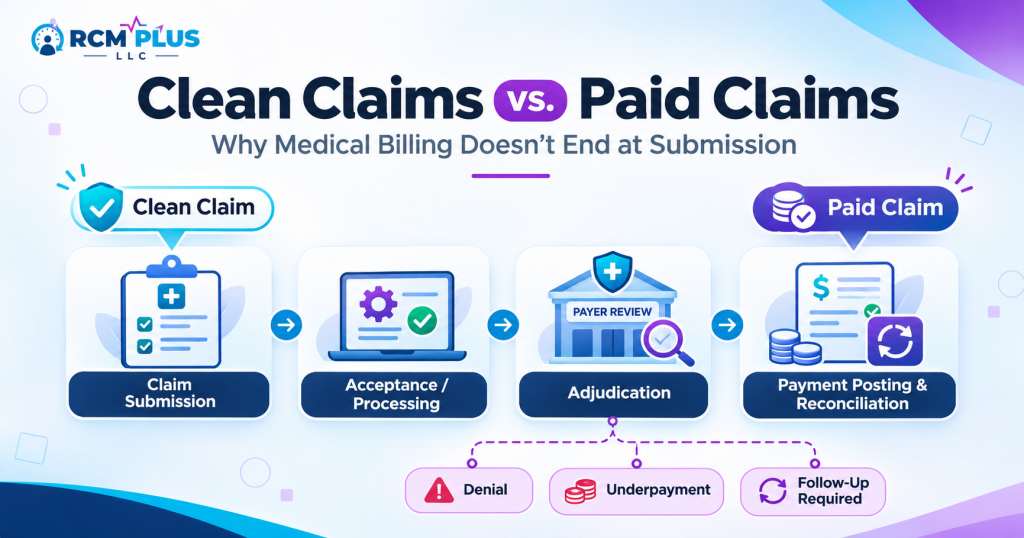
The Four Checkpoints Every Practice Should Understand
1. Was the claim successfully transmitted?
Most electronic professional claims use the HIPAA-standard 837 transaction.
A billing system or clearinghouse may confirm that a file was transmitted. However, transmission alone does not establish that every claim passed subsequent edits.
Acknowledgment reports, including the 999 transaction where applicable, help identify whether the electronic transaction passed relevant processing checks.
What to check: Transmission status, acknowledgment results, and any batch-level errors.
2. Did the payer accept the individual claim?
A claim may pass one level of validation but fail a later payer edit.
A 277CA acknowledgment, where used, can communicate acceptance or rejection of individual claims.
A rejected claim generally needs its submission error investigated and corrected before it can proceed through normal adjudication.
What to check: Claim-level acknowledgment, rejection reason, payer claim number when available, and corrective action.
3. What happened during adjudication?
Once a claim is accepted for processing, the payer evaluates it according to applicable coverage, benefits, coding, and payment requirements.
Possible outcomes include payment, partial payment, denial, or other adjudication results.
A claim accepted for processing can still be denied. An acceptance acknowledgment is not a promise of reimbursement.
What to check: Payer claim status, denial reasons, required documentation, and whether further action is appropriate.
4. Was the financial outcome reconciled?
After adjudication, the revenue cycle still requires accurate accounting.
The electronic remittance advice, commonly the 835 transaction, communicates payment and adjustment information. Billing staff must review the relevant adjustment codes, payment amounts, contractual obligations, and any indicated patient responsibility.
An insurer’s payment notification also needs to be reconciled with the practice’s payment records and, where applicable, bank deposits.
What to check: Allowed amounts, actual payment, contractual adjustments, payer offsets, posting accuracy, and remaining balances.
Where Revenue Can Get Stuck After Submission
A claim does not need to be incorrectly submitted for a practice to experience a collection problem. Consider four common operational gaps.
Rejections that are never corrected
A clearinghouse or payer rejection may remain in a work queue without a clear owner.
If the issue is not identified quickly, the claim can remain unprocessed while the applicable filing deadline continues to matter.
A structured rejection workflow should assign responsibility, document corrective action, and confirm whether the resubmitted claim was accepted.
Denials without a defined next step
Not every denial requires the same response.
Some may involve correcting claim information. Others may warrant reconsideration, a formal appeal, additional documentation, or an evaluation of whether further action is appropriate.
The right response depends on the payer’s reason codes, applicable policies, contractual requirements, and relevant deadlines.
Repeatedly resubmitting the same claim without identifying its actual problem is not an effective denial management strategy.
Aging accounts receivable without prioritization
An aging report shows how long balances have remained unresolved. It does not automatically explain why they remain outstanding.
For example, a claim in the 90-day aging category might be pending additional information, awaiting payer review, denied, underpaid, or incorrectly posted.
These situations require different actions.
Practices benefit when aging A/R worklists are prioritized using claim status, payer, balance, deadline, denial reason, and realistic recovery options.
Payment discrepancies that go unnoticed
A payment can be received and posted without necessarily confirming that the reimbursement matches the applicable agreement.
A contractual underpayment, incorrect adjustment, payment offset, or posting discrepancy may require further investigation.
The goal is not to challenge every payment. It is to identify exceptions that can be supported with accurate contract, claim, and remittance information.
A Practical Example: Accepted, but Still Unresolved
Imagine a practice submits a claim for a completed office visit.
The clearinghouse reports successful transmission. The payer subsequently accepts the claim for processing.
Several weeks later, the account remains unpaid.
If the billing team looks only at the original submission report, nothing appears wrong. But a current payer status inquiry may reveal that additional information is required or that an adjudication decision has already been issued.
The appropriate next step depends on that finding.
This is a hypothetical example, but it illustrates an important operational distinction:
A successful submission report tells you what happened at submission. It does not tell you whether the claim reached a correct financial resolution.
Five Billing Controls Worth Reviewing
Practice administrators do not need to personally investigate every claim. They do need reporting that shows whether unresolved work is being managed.
- Claim acknowledgment review: Confirm that transmitted claims receive the expected acknowledgments and that rejections are assigned for correction.
- Denial categorization: Group denials by reason, payer, specialty, and recurring workflow issue.
- A/R follow-up tracking: Identify outstanding claims, last meaningful action, next step, responsible team member, and deadline.
- Payment variance review: Investigate supported differences between expected contractual reimbursement and actual payment.
- Routine reporting: Review trends in rejections, denials, aging balances, payment exceptions, and unresolved accounts.
These controls help answer a more useful question than simply how many claims were submitted:
What happened to the claims after submission, and what remains unresolved?
Frequently Asked Questions
Can a clean medical claim still be denied?
Yes. A claim may satisfy initial submission requirements and still be denied during adjudication because of coverage, medical necessity, benefit limitations, or other payer-specific requirements.
Is claim acceptance the same as claim payment?
No. Claim acceptance generally means the payer or processing system has accepted the claim for a subsequent stage of processing. Payment or denial is determined through adjudication.
What is the difference between a rejected claim and a denied claim?
A rejected claim generally fails a submission or processing edit and must be corrected before normal adjudication can proceed. A denied claim has generally been evaluated during adjudication and determined not payable, in whole or in part, according to the applicable reason.
The exact handling process depends on the payer and claim status.
What should a practice review when medical claims remain unpaid?
Start by confirming the claim reached the payer, checking the latest status, reviewing available acknowledgments and remittance information, and identifying any applicable deadline. Then assign and document the appropriate next action.
A Stronger Revenue Cycle Requires Follow-Through
Submitting accurate claims remains essential. It reduces avoidable errors and supports efficient processing.
But submission quality is only one part of effective medical billing.
Practices also need visibility into payer acceptance, adjudication, denial resolution, payment posting, underpayments, and aging receivables.
At RCM Plus LLC, we approach revenue cycle management as a connected operational process, with attention to claim quality, documented payer follow-up, and clear reporting.
The objective is not simply to submit more claims. It is to help practices understand where claims stand, what needs action, and whether financial outcomes have been reconciled correctly.
Want a Clearer Picture of Your Billing Performance?
A focused medical billing audit can help identify unresolved claims, aging A/R patterns, denial trends, and reimbursement exceptions within an agreed review scope.
Request a Free Billing Audit or explore our Medical Billing Services.
Please do not submit patient-identifying information through public inquiry forms or chat. Any sensitive review should follow appropriate secure information-sharing arrangements.