Medical claim denials are rarely solved by clicking “resubmit” and hoping for a different result. A denial can reflect a coverage issue, missing records, an authorization requirement, a coding discrepancy, or a payer decision that needs to be challenged. The next step depends on what actually happened to the claim.
Consider a practice that sees the same denial label appear on several claims. One account may need corrected information. Another may require supporting clinical documentation. A third may be waiting for an appeal decision. Treating all three as identical work creates repeat denials and unnecessary follow-up.
A useful denial-management process begins with a simple question: What is the verified root cause, and which response is permitted for this payer and claim status?
Table of Contents
Medical Claim Denials vs. Rejections: Know the Difference
A rejected claim generally fails an intake, format, or claim-level edit before ordinary adjudication can proceed. Depending on the system, it may be rejected by a clearinghouse, a payer front end, or a subsequent processing edit. The submitting team needs to identify the rejection message, correct the underlying issue, and confirm the payer accepts the next submission.
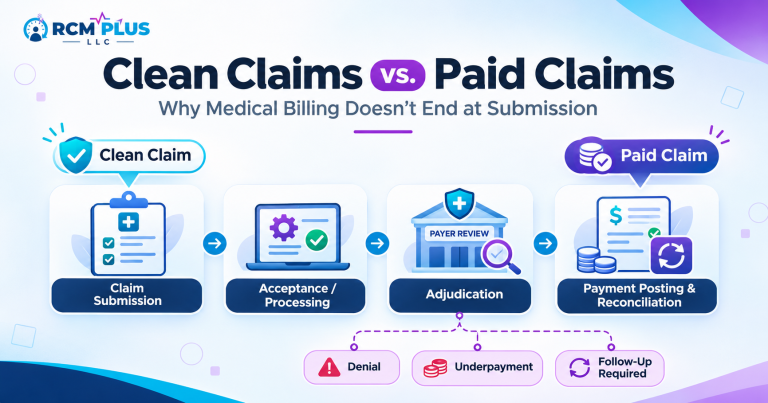
A denied claim has generally undergone a payer determination that a submitted charge or service is not payable, in whole or in part, under the applicable rules. The decision may be reported on a remittance advice and may carry correction, review, or appeal options. An underpayment is different again: the claim may be paid, but the amount requires comparison with the applicable contract and adjustment information.
Electronic acknowledgments help distinguish these stages. A 999 implementation acknowledgment relates to transaction-level compliance; a 277CA, where used, can communicate claim-level acceptance or rejection. Neither means the service has been approved for reimbursement. The later 835 electronic remittance advice communicates adjudication and payment adjustments. For further status checks, a 276 inquiry and 277 response may be available. See the CMS references at the end of this article.
Start With the Evidence, Not the Denial Label
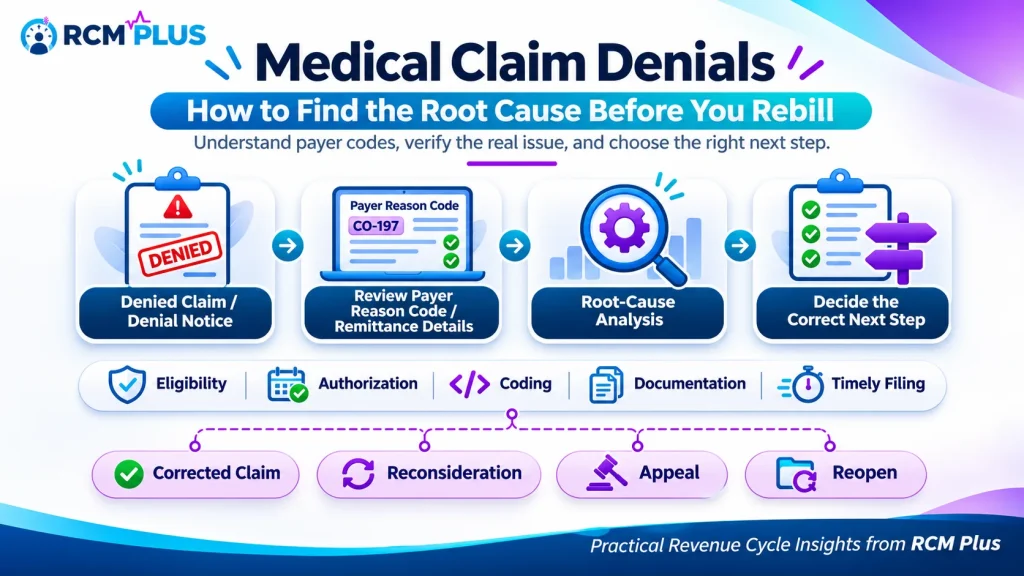
A work queue that says only “denied” does not tell a biller what to do. Before touching the claim, identify its current state using the available submission response, payer portal, remittance advice, and claim history.
- Match the correct claim and service line. Confirm payer, claim number when available, date of service, billed services, and whether the issue affects the whole claim or one line.
- Read all relevant adjustment details. Review the group code, Claim Adjustment Reason Code (CARC), and any Remittance Advice Remark Code (RARC). A shorthand denial description in billing software may omit the detail that changes the next step.
- Compare against supporting records. Check eligibility, authorization records when applicable, coding, documentation, payer policy, prior submissions, and any earlier correspondence.
- Verify the applicable deadline. Original filing, correction, reconsideration, and formal appeal periods may be different. Do not assume that resubmitting a claim restarts the clock.
- Choose and document one clear action. Record the reason, responsible owner, supporting evidence, submission method, confirmation, and next review date.
This is not about making every denial an appeal. It is about avoiding an action that does not address the reason the claim stopped moving.
Six Root Causes Worth Investigating
1. Eligibility and benefit mismatches
The patient may have been ineligible on the date of service, the service may be excluded from the benefit, or the billed payer may not be responsible for the claim. Verification must match the actual service date, plan, and benefit question. A general “active coverage” check does not establish that every service is covered.
2. Enrollment, provider, or claim-routing problems
A valid service can encounter trouble when billing and rendering provider details, identifiers, practice location, taxonomy, or enrollment status do not match payer records. The correct response may involve a credentialing or enrollment review rather than changing clinical codes.
3. Missing or inconsistent claim information
Demographic mismatches, invalid identifiers, absent required fields, and inconsistencies between submitted details and payer records can prevent processing. Investigate whether the issue was a front-end rejection or an adjudicated denial before deciding how to submit a correction.
4. Coding, modifiers, and documentation
Diagnosis specificity, procedure-code selection, modifiers, units, bundling edits, and documentation can affect payment. A coding change must be supported by the clinical record and applicable coding rules. An unsupported modifier or higher service level should never be added merely to obtain payment.
5. Authorization, referral, or medical-necessity requirements
A payer may request an authorization reference, evidence of a required referral, or documentation demonstrating the applicable coverage criteria. These are not interchangeable issues: obtaining authorization after a service, submitting requested documentation, and disputing a medical-necessity decision may follow different payer processes. Even a prior authorization approval does not eliminate all claim-payment requirements.
6. Coordination of benefits and duplicate-claim concerns
If another insurer should be primary, the payer may require information about the earlier adjudication. Duplicate edits may also be triggered by repeated submissions or services that appear identical. Before submitting another claim, check whether the payer has already received, denied, or paid an earlier version.
Corrected Claim, Reconsideration, Reopening, or Appeal?
These terms are often used as though they mean the same thing. They do not. The right option depends on payer rules, the exact claim status, the issue being challenged, and how much time remains.
Corrected or replacement claim
Use the payer-prescribed correction or replacement process when accurate claim information needs to be amended and that process is allowed for the issue. Confirm the required claim frequency or original-reference information before submitting. Sending a new original claim in place of a correction can create a duplicate problem.
Reconsideration or payment dispute
Some payers offer a review or reconsideration route for certain denials, coding questions, or payment disputes. Check the payer’s specific instructions and whether that review has any effect on a formal appeal deadline. Do not assume an informal inquiry preserves appeal rights.
Medicare reopening
For Original Medicare fee-for-service, some minor errors and omissions can be handled through a reopening. CMS treats reopenings as distinct from appeals, and requesting one generally does not stop the appeal filing period. Whether a reopening is appropriate depends on the type of error and Medicare contractor instructions.
Formal appeal
Use the applicable appeal pathway when contesting an adjudicated decision and the issue qualifies for review. The submission should explain the disagreement and include the relevant evidence. For example, CMS generally allows 120 days from receipt of the initial determination to request a first-level redetermination for Original Medicare fee-for-service. That is not a universal deadline for Medicare Advantage, Medicaid, or commercial insurance.
Practical rule: Never choose a route solely because it appears as a button in the billing system. Verify the payer process and the clock first.
Four Similar Accounts, Four Different Next Steps
The following scenarios are hypothetical. They illustrate how root-cause analysis changes the work, not how any specific payer must decide a claim.
- Claim A: Rejected for an identifier mismatch. The claim never reached normal adjudication. Confirm the correct information, use the appropriate submission route, and verify acceptance before treating it as resolved.
- Claim B: Denied following a medical-record request. Confirm the request, denial basis, documentation available, and the payer’s permitted review or appeal path. Uploading records through the wrong process may not resolve the denial.
- Claim C: Denied for an authorization-related issue. Confirm the service, applicable plan requirement, authorization history, and any allowed exception or review process. Do not invent or backdate an authorization.
- Claim D: Paid below the expected contracted amount. Reconcile the allowed amount, contract terms, remittance adjustments, and other payer information before deciding whether a supported payment dispute is appropriate.
All four accounts can appear on a denial or exception dashboard, yet only one may involve an ordinary rejected-claim correction. This is why categorization by verified reason is more useful than a queue sorted only by dollar amount.
Build a Denial Worklist That Prevents Repeat Errors
A strong denial workflow does two jobs at once: it resolves individual claims and identifies patterns that can be prevented upstream. For practice administrators, those two outcomes should be visible in reporting.
- Assign a reason and an owner. Group by verified payer reason, not just a generic “insurance denial” status. Record the next action and due date.
- Separate correction work from disputes. A rejected claim, a claim needing medical records, and a contract-rate question should not share the same action template.
- Track acknowledgments and results. After submitting a corrected claim or appeal, confirm it was received and periodically check the appropriate status. “Sent” is not the same as “resolved.”
- Connect findings to front-end teams. Repeated eligibility, authorization, registration, or documentation issues should feed a specific training or process change.
- Reconcile the final outcome. Verify the remittance, payment posting, adjustments, secondary billing when relevant, and any valid remaining patient responsibility.
The goal is not to eliminate every denial. Payers may make legitimate coverage determinations and some services are not payable. The goal is to make each denial understandable, time-sensitive where necessary, and appropriately resolved.
What Should a Practice Measure Each Month?
Track a small set of metrics consistently rather than collecting dozens of figures that no one uses. Agree on the definition and denominator for each measure before comparing periods.
- Initial denial rate: The share of claims (or claim lines) denied on first adjudication, with the chosen denominator clearly documented.
- Top denial reasons by payer: Counts and values by reason, specialty, and repeat-workflow issue, with coding consistent over time.
- Time to first meaningful action: How quickly a denial is reviewed and assigned its correct route, especially where deadlines matter.
- Appeal and correction outcomes: Which submissions were received, overturned, upheld, still pending, or withdrawn, and how much was actually collected.
- Open accounts with no next step: An operational backlog indicator that identifies work at risk of being forgotten.
A claim-level report should let the manager answer, “What changed since the last review?” If the answer is only that the claim is another month older, the workflow probably needs attention.
Frequently Asked Questions About Medical Claim Denials
Is a rejected medical claim the same as a denied claim?
No. A rejection generally means the claim failed a processing edit before normal adjudication. A denial generally reflects a payer determination about payment. Review the actual electronic response or remittance to establish which happened.
Should a denied claim always be resubmitted?
No. Repeated submission without identifying the issue can create duplicate claims and consume filing time. Depending on the payer and denial reason, the correct action might be a replacement claim, review request, appeal, documentation submission, or no further action.
Does prior authorization guarantee the claim will be paid?
No. Authorization and final claim payment are different decisions. Other coverage, coding, eligibility, documentation, and claim-submission requirements can still apply.
Can an insurance denial automatically become a patient bill?
No. The remittance codes, contract, plan benefits, secondary coverage, applicable law, and actual patient responsibility must be reviewed. A denial is not, by itself, permission to transfer the balance to the patient.
The Better Question Is: Why Did This Claim Stop?
Medical claim denials become manageable when the team stops treating them as one undifferentiated backlog. Start with the status, confirm the reason, choose the payer-approved route, document the action, and verify the financial result. Then use the pattern to prevent the next avoidable exception.
At RCM Plus LLC, our approach connects denial review with eligibility, billing accuracy, payer follow-up, A/R management, and payment reconciliation. The useful outcome of a denial analysis is not a bigger spreadsheet. It is a documented explanation of what needs to happen next.
A focused audit can examine a defined, appropriately authorized sample of denials, rejected claims, and unresolved A/R. Scope and secure information-sharing arrangements are agreed before claim-level review. Request a Free Billing Audit or discuss your practice with our team.
Please do not submit patient names, dates of birth, insurance identifiers, medical records, or other patient-identifying information through public forms or chat.