Aging accounts receivable can look like an ordinary number on a medical practice’s monthly financial report. But that number may represent unpaid insurance claims, unresolved denials, missing payments, or work that has not been touched in weeks. The real cost is not simply waiting for money. It is losing visibility into why the balance remains open and what action is still possible.
For practice owners and administrators, the most useful question is not just, “How much A/R is over 90 days?” It is, “Which balances have a verified status, an assigned next action, and a deadline we can still meet?”
A well-managed receivables process separates a claim that is legitimately pending from one that has stalled. Without that distinction, even a detailed aging report can create a false sense of control.
Note: The A/R balances shown in the accompanying infographic are illustrative examples, not actual practice data or industry benchmarks.
Table of Contents
What Does Aging Accounts Receivable Mean in Medical Billing?
Accounts receivable (A/R) represents amounts recorded as outstanding for services already provided. An A/R aging report groups open balances according to how long they have remained unpaid, often in buckets such as 0–30, 31–60, 61–90, 91–120, and more than 120 days.
One detail matters: confirm what starts the aging clock. Depending on the software and report configuration, aging may be measured from the date of service, posting date, billing date, or another reference point. Two reports cannot be compared fairly if they use different starting dates or treat credits and adjustments differently.
Older does not automatically mean uncollectible. A balance may still be under valid review, awaiting secondary insurance, tied to a documented appeal, or incorrectly displayed because a payment was not posted. The age tells us where to investigate; it does not tell us the outcome.
The Hidden Costs of Leaving Medical A/R Unresolved
1. Cash flow becomes harder to forecast
A practice may have substantial billed revenue on paper while receiving cash unevenly. When expected payments remain tied up in unresolved accounts, staffing, vendor obligations, and operational planning become harder to manage. A/R should be analyzed alongside actual collections and adjustment activity, not treated as a substitute for available cash.
2. Staff time shifts from resolution to repeated checking
Without a documented next step, the same account can be opened repeatedly by different team members. One person checks a portal; another calls the payer later; neither records what was established. This is work, but it is not necessarily progress.
A useful follow-up note should capture the verified payer status, the specific issue, the action taken, a reference number when available, the responsible owner, and the next review date.
3. Correctable problems become harder to recover
An unworked rejection, missing documentation request, or overlooked denial can reach a deadline before anyone identifies the correct response. Filing and appeal timeframes vary by payer, plan, contract, jurisdiction, and claim type. They should never be inferred from the aging bucket alone.
For example, Original Medicare fee-for-service claims generally must be filed within one calendar year after the date of service, subject to limited exceptions. That rule should not be used as a blanket deadline for commercial or Medicaid claims, nor confused with an appeal deadline.
4. Payment discrepancies remain hidden
A balance may be marked outstanding even after payment because remittance posting, EFT matching, contractual adjustments, or secondary billing were incomplete. The opposite can also happen: an account may be closed despite a supported underpayment.
Remittance details matter. CMS explains that electronic remittance advice communicates adjustments using group codes, Claim Adjustment Reason Codes (CARCs), and, where applicable, Remittance Advice Remark Codes (RARCs). Those details help determine the correct accounting and follow-up action. A balance alone does not justify transferring responsibility to the patient.
Why Three 90-Day-Old Claims May Need Different Actions
Consider three hypothetical insurance accounts that appear in an aging report with similar balances:
- Account A: The claim is accepted, and the payer confirms a pending review. The team needs to record the current status and the next appropriate inquiry date.
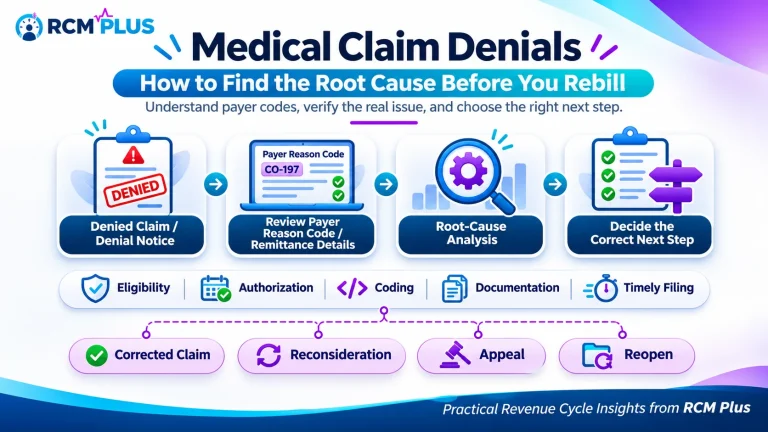
- Account B: The claim was denied, and the remittance identifies a specific reason. The team must determine whether the correct route is a correction, reconsideration, appeal, or another payer-defined process, and verify the deadline.
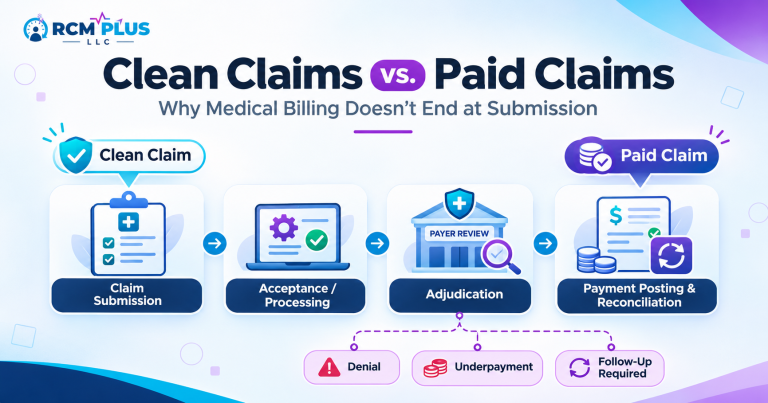
- Account C: The payer reports payment, but the practice cannot match it to the posted transaction or bank deposit. The immediate task is payment tracing and reconciliation, not another claim submission.
All three accounts are old. Yet treating them as one generic “follow up with insurance” queue wastes time and can lead to the wrong action. Good A/R management begins with a verified reason for the open balance.
How to Prioritize an A/R Follow-Up Worklist
Age is a useful starting filter, but a practical queue also considers claim status, filing or appeal deadlines, collectible balance, payer requirements, and the last meaningful action. A simple framework is:
- Identify urgent deadline risk. Flag claims approaching a verified filing, correction, reconsideration, or appeal cutoff. Do not wait for them to become 90 days old.
- Separate claim states. Create distinct work queues for rejected, denied, pending, underpaid, secondary-payer, patient-responsibility, and payment-reconciliation accounts.
- Find untouched accounts. Look for claims with no documented meaningful follow-up, not just those with an old date.
- Assign ownership and next action. Every worked item should have an accountable owner, evidence of what was checked, and a scheduled next step.
- Close the loop. Confirm the correction was accepted, the appeal received, the payment posted, or the balance appropriately adjusted. A phone call alone is not resolution.
For Medicare claims, CMS describes several ways to check current status, including Medicare Administrative Contractor portals and electronic 276 claim-status requests with 277 responses. Available options for other payers may differ.
Three Metrics That Reveal More Than Total A/R
Net days in accounts receivable
HFMA’s MAP Keys define net days in A/R as net accounts receivable divided by average daily net patient service revenue. The daily revenue figure is calculated using the most recent three months of net patient service revenue and the actual number of days in that period. Using a consistent calculation helps practices compare performance across reporting periods.
Illustrative calculation: If net A/R is $150,000 and average daily net patient service revenue is $3,000, net days in A/R would be 50. This is an arithmetic example, not a benchmark or a conclusion about any particular practice.
Share of A/R in older aging buckets
Review the percentage of outstanding A/R in bands such as over 90 and over 120 days, using a consistent denominator. A rising older-balance share can signal follow-up backlogs, payer delays, unresolved denials, or accounting issues. It does not identify which of those problems is responsible without account-level review.
Accounts lacking a meaningful next action
A useful operational measure is the number or value of claims with no verified status, no assigned owner, or no documented next step. This is an internal management metric rather than a universal industry standard, but it helps distinguish visible work from stalled work.
The goal is not to produce an impressive dashboard. It is to make the report point to a specific decision.
A Five-Step A/R Review for Practice Administrators
An effective review does not require every account to be worked in one sitting. Start with a defined, appropriately authorized sample and use it to test whether the workflow is reliable.
- Validate the report. Confirm its aging basis, payer mix, credit handling, and whether totals reconcile with the practice-management system.
- Pull a stratified sample. Include a mix of older balances, recent denials, high-priority exceptions, and claims reported as paid but still open.
- Verify the current status. Check payer portals, remittance records, claim acknowledgments, and documented correspondence using approved access.
- Record the root cause. Separate true payer delays from missed follow-up, denial issues, posting gaps, coordination-of-benefits problems, and contractual payment variances.
- Report actions and ownership. Summarize which claims require correction, appeal evaluation, further documentation, payment tracing, or appropriate closure.
Use secure, authorized channels for any claim-level review. Public web forms and chat are not appropriate places to submit patient-identifying information.
Frequently Asked Questions About Aging Medical A/R
Is A/R over 90 days always bad?
No. It deserves investigation, but not every older balance is avoidable or uncollectible. Some claims have documented payer activity or legitimate pending circumstances. The important question is whether the practice knows the status, risk, and next action.
How often should a practice review aged accounts receivable?
The appropriate cadence depends on claim volume, specialty, payer mix, and staffing. Time-sensitive exceptions should be monitored before deadlines, while recurring summary reporting should reveal trends and unresolved work. A monthly summary by itself is not a substitute for ongoing follow-up.
Does a denied claim require a corrected claim?
Not always. Some issues call for correction, while others may require payer reconsideration, a formal appeal, or supporting documents. The response must follow the actual denial reason, payer rules, and applicable time limits.
Can old insurance balances automatically be billed to patients?
No. Patient responsibility must be determined from the applicable remittance, coverage, contract, and other account information. An old insurer balance is not by itself evidence that a patient owes the amount.
The Goal Is Resolution, Not Just a Smaller Aging Report
A/R aging is valuable because it identifies where the revenue cycle needs attention. It becomes more useful when every material balance has a reason, a responsible owner, and a realistic next step.
At RCM Plus LLC, we look at receivables in the context of claim status, denial reasons, payer follow-up, payment posting, and reporting. A practice should be able to distinguish genuine reimbursement delays from avoidable workflow gaps and financial posting exceptions.
If you want to understand where your outstanding claims are getting stuck, a focused audit can examine a defined sample of aging balances, denials, and reimbursement questions after scope and secure information-sharing requirements are agreed.
Request a Free Billing Audit or discuss your practice with RCM Plus LLC.
Please do not share patient names, dates of birth, insurance IDs, or other patient-identifying information through public inquiry forms or chat.