
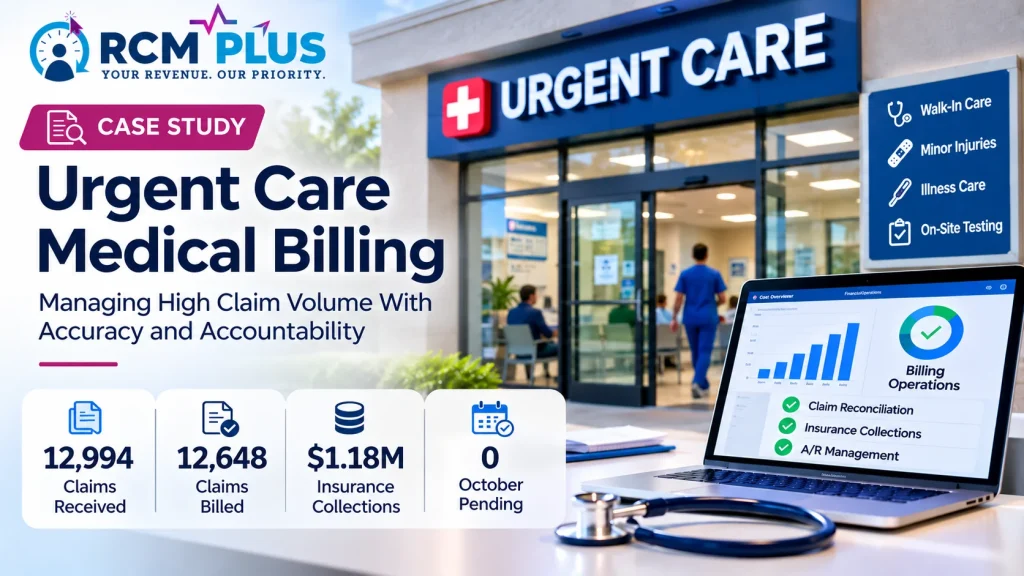
An inside look at ten months of claim reconciliation, insurance collections, and accounts receivable oversight.
This Urgent Care Medical Billing Case Study examines how RCM Plus LLC supported a high-volume U.S. urgent care practice through structured claim reconciliation, provider coordination, insurance collections monitoring, and accounts receivable oversight. From January through October 2026, the practice recorded 12,994 claims received and 12,648 claims billed.
Specialty: Urgent Care
Reporting Period: January to October 2026
Practice: Independent U.S. Urgent Care Facility (Identity Confidential)
In This Case Study
When Claim Volume Is High, Every Detail Matters
An urgent care practice can treat hundreds of patients every week, but completing those visits is only the beginning of the revenue cycle.
Behind every claim is a series of administrative responsibilities: verifying information, reviewing charges, identifying documentation issues, submitting claims, tracking payer responses, reconciling payments, and following up on outstanding balances.
When a practice processes more than a thousand claims each month, small workflow gaps can become difficult to manage without consistent reporting.
At RCM Plus LLC, we believe effective revenue cycle management is not simply about sending claims to insurance companies. It is about maintaining visibility and accountability from the time charges are received through payment reconciliation.
This case study examines ten months of actual operational reporting from an independent U.S. urgent care practice.
The Operational Challenge
Urgent care billing requires close attention to the movement of claims through multiple stages. Some claims are ready for submission when received. Others require clarification regarding documentation, coding, or information supplied by the provider’s office.
Submitting a claim without addressing identified issues can create avoidable downstream problems. At the same time, allowing those claims to remain untracked can delay billing activity.
For this practice, the operational priority was to maintain a consistent reconciliation process that could distinguish claims received, claims billed, and items requiring further attention.
The practice also required ongoing visibility into insurance collections and outstanding accounts receivable.
This urgent care medical billing case study highlights why consistent reconciliation and provider communication matter when managing thousands of claims. Having a clear process for identifying discrepancies helps teams understand which claims are ready for submission and which require additional information.
Our Approach: Reconciliation Before Submission
Our operational reporting focused on three interconnected responsibilities: tracking claim activity, monitoring insurance collections, and reviewing outstanding receivables.
1. Tracking Claims Received Against Claims Billed
We maintained a monthly comparison between claims received from the practice and claims processed for billing.
When the received and billed totals differed because additional information was needed, the matter was referred to the provider’s office for clarification.
This is an important distinction. A claim awaiting information should not automatically be treated as a rejected claim, an insurance denial, or lost revenue.
By identifying these differences, the workflow allowed outstanding questions to remain visible instead of being overlooked.
The distinction between rejected and denied claims is also important during insurance processing. The Centers for Medicare & Medicaid Services (CMS) explains how electronic Medicare claims undergo initial validation and subsequent payment-policy review, with different circumstances resulting in rejections or denials.
2. Monitoring Insurance Collections
Claim submission represents only one stage of the revenue cycle. Actual insurance payments must also be monitored and reconciled.
Our monthly operational report tracked insurance collections, including payer-level payment totals, to provide visibility into recorded reimbursement activity.
This distinction matters because a submitted claim is not necessarily an accepted claim, and an accepted claim is not necessarily a paid claim.
Maintaining visibility into insurance collections helps practice administrators review recorded reimbursement activity alongside their billing workload and outstanding balances.
3. Reviewing Accounts Receivable
Outstanding accounts receivable (A/R) requires visibility into unpaid insurance balances and their age.
The operational reporting included insurance aging information to support follow-up reviews and identify balances requiring investigation.
A/R monitoring is essential because older claims may require different actions depending on payer responses, payment status, filing requirements, and the reasons a balance remains outstanding.
For more information about our specialty-focused workflows, explore the medical specialties supported by RCM Plus LLC.
The Results: Ten Months of Documented Operations
Between January and October 2026, the practice’s operational reporting recorded the following performance indicators:
| Performance Indicator | Reported Result |
|---|---|
| Claims Received | 12,994 |
| Claims Billed | 12,648 |
| Aggregate Billed-to-Received Ratio | 97.3% |
| Reported Insurance Collections | Approximately $1.18 Million |
| October Claims Received | 1,188 |
| October Claims Billed | 1,188 |
| October Reported Pending Claims | 0 |
The aggregate difference between claims received and claims billed was 346. Under the practice’s reporting workflow, these differences were associated with items requiring clarification from the provider’s office.
This cumulative difference does not necessarily represent 346 unique unresolved claims. Some items may move between reporting periods, and the totals should not be interpreted as a claim denial count.
In October 2026, the report recorded 1,188 claims received and 1,188 claims billed, with zero pending claims reported for that month.
The insurance collections figure represents payments recorded during the reporting period. It should not be interpreted as the payment rate of claims billed during those same months, because payments may relate to claims from earlier periods.
These results demonstrate documented billing activity, payment visibility, and monthly reconciliation. They do not, by themselves, establish a reduction in denials or an increase in collections attributable to a particular intervention.
The figures in this urgent care medical billing case study illustrate the scale of the reporting activity and the importance of reviewing multiple operational indicators together rather than relying on claim volume alone.
What This Case Study Demonstrates
One of the most important lessons from this urgent care medical billing case study is that revenue cycle performance cannot be assessed through claim volume alone.
A practice may submit a large number of claims while still facing unresolved documentation questions, outstanding payer balances, or payment reconciliation challenges.
A disciplined billing process should make these issues visible rather than allowing them to remain hidden inside routine monthly totals.
For this urgent care operation, monthly reporting connected claim activity, provider-office clarification requirements, recorded insurance collections, and A/R aging into a structured operational view.
That visibility matters to practice administrators who need to understand not only how much work was completed, but also which items still require attention.
The RCM Plus LLC Perspective
We believe a strong revenue cycle operation should be measurable, transparent, and accountable.
Whether a practice handles several hundred claims or several thousand each month, the fundamentals remain the same: accurate claim preparation, appropriate escalation of missing information, payment reconciliation, and continued attention to outstanding receivables.
The goal is not simply to report how many claims were submitted. It is to help the practice understand what happened after those claims entered the revenue cycle.
This is the operational philosophy reflected throughout our urgent care medical billing case study: structured reporting, careful reconciliation, and accountability for outstanding items.
Learn more about our revenue cycle management services, including billing operations, denial follow-up, A/R management, and financial reporting.
Secure, accurate, and always accountable.
Is Your Practice Getting the Full Picture?
If your practice receives monthly billing reports but still struggles to understand claim discrepancies, outstanding A/R, denials, or insurance payments, a structured review may help identify areas requiring attention.
RCM Plus LLC offers a complimentary practice billing audit to evaluate revenue cycle workflows and potential opportunities for improvement.
Confidentiality and reporting note: This case study presents aggregated operational information from a real urgent care billing report. The practice’s identity, patient information, and individual payer financial details have been excluded. Performance figures represent the stated reporting period and should not be interpreted as guaranteed outcomes for other practices.